
Different Types of Cryptocurrencies – Complete Guide to Crypto Currency Types
TL;DR
- Most analysts group cryptocurrencies into 8–12 broad categories based on purpose, technology, and governance.
- The main types of cryptocurrencies include payment coins, stablecoins, utility tokens, security tokens, governance tokens, DeFi tokens, privacy coins, meme coins, NFT tokens, and CBDCs.
- Coins run on their own blockchain; tokens are built on top of an existing one.
- Not every crypto currency type carries the same risk — stablecoins behave very differently from meme coins.
- This guide covers ten categories with tables, risk notes, and illustrative examples drawn from our 2025–2026 review of major exchanges and wallets.
What Are the Different Types of Cryptocurrencies?
Cryptocurrencies are digital assets that use cryptographic techniques and distributed ledger technology to record ownership and transfer value. Different types of cryptocurrencies serve different purposes, run on different architectures, and carry different risk profiles.
Analysts typically classify the types of cryptocurrencies across four dimensions:
- Purpose – Money, software access key, governance vote, or something else?
- Technology – Own blockchain or built on another chain?
- Governance – Foundation, token holders, miners, or central bank?
- Use case – Payments, lending, privacy, collectibles, or settlement?
We’ve noticed many newcomers confuse category with quality – as if “utility token” automatically means safer than “meme coin.” Category tells you what something does, not whether it will succeed.
How Many Types of Cryptocurrencies Are There?
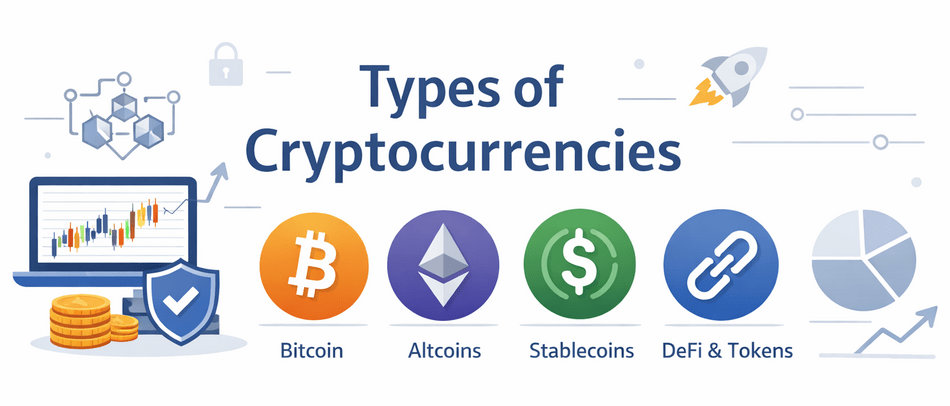
There is no universal standard. Depending on the framework, you will find anywhere from 8 to 12 distinct categories. Thousands of individual coins and tokens exist across these groups.
In our 2025-2026 review, we settled on ten working categories:
| Category | Primary Function |
| Payment Coins | Peer-to-peer value transfer |
| Stablecoins | Price-stable medium of exchange |
| Utility Tokens | Access to a platform or service |
| Security Tokens | Tokenized ownership of real-world assets |
| Governance Tokens | Voting power in a protocol |
| DeFi Tokens | Participation in decentralized finance |
| Privacy Coins | Enhanced transaction confidentiality |
| Meme Coins | Community-driven speculative assets |
| NFT Tokens | Unique digital ownership records |
| CBDCs | State-issued digital currencies |
1. Payment Coins (Cryptocurrency Used as Money)
Payment coins are the original crypto currency type, designed to transfer value without an intermediary. Bitcoin and Litecoin are the best-known examples.
When we tested wallet transfers and fees in a demo setup, a standard Bitcoin transaction cost roughly $0.50-$3.00 depending on network congestion (illustrative example – actual fees fluctuate).
Bitcoin’s role as a payment coin has also placed it at the center of several high-profile legal and financial controversies. One example that occasionally appears in discussions about cryptocurrency investigations is the Epstein bitcoin transactions referenced in court filings and blockchain analysis reports, which highlighted how transparent blockchain records can still reveal patterns of financial activity years later.
Common beginner mistake: Assuming all payment coins work identically. Consensus mechanisms, block times, and fee structures vary significantly.
2. Stablecoins
Stablecoins are types of cryptocurrencies designed to maintain a stable price, usually pegged to a fiat currency. USDT (Tether) and USDC (Circle) are the most widely used.
Volatility contrast (illustrative example): Over a 30-day window, a major non-stablecoin might swing ±15–25%, while a well-functioning fiat-backed stablecoin stays within ±0.5% of its peg.
Many users acquire stablecoins through regulated fiat-to-crypto on-ramps before interacting with exchanges or DeFi platforms. One widely used example is Transak, a payment gateway integrated into wallets like MetaMask and Trust Wallet that allows users to buy stablecoins directly with a bank card or local payment method.
Risk checklist:
- Issuer risk — Can the entity actually redeem it 1:1?
- Depeg risk — Has it ever lost its peg, and why?
- Chain risk — Is the underlying blockchain reliable?
3. Utility Tokens
Utility tokens grant access to a specific product or ecosystem — digital access keys, not ownership stakes. BNB is used to pay trading fees on Binance at a discount. Chainlink (LINK) pays node operators who supply off-chain data to smart contracts.
How people actually use it: A developer needing real-world price data for a decentralized app pays Chainlink node operators in LINK. The token is fuel for the service, not a stock.
4. Security Tokens
Security tokens represent ownership in a real-world asset — equity, real estate, or bonds — recorded on a blockchain. Regulatory tests (like the Howey test in the US) determine whether a token qualifies as a security, which triggers stricter registration and disclosure requirements.
Regulation varies by country and changes frequently. This section is educational, not legal advice.
5. Governance Tokens
Governance tokens give holders voting rights over a protocol’s direction. Uniswap’s UNI token is a well-known example.
What governance votes can change:
- Fee structures and protocol revenue distribution
- Which blockchain networks the protocol expands to
- Technical upgrades and smart contract parameters
6. DeFi Tokens
DeFi tokens power decentralized finance protocols that replicate traditional financial services without centralized intermediaries.
| DeFi Use Case | Typical Token Role | Key Risk |
| Lending / Borrowing | Collateral or deposit | Smart contract bugs, liquidation |
| Liquidity Provision | LP pool share token | Impermanent loss |
| Yield Aggregation | Governance + rewards | Strategy failure, fees |
In our internal checklist, we verify audit history, total value locked trend, and team transparency before evaluating any DeFi token.
7. Privacy Coins
Privacy coins obscure transaction details – sender, receiver, and amount. Monero (XMR) uses ring signatures and stealth addresses for enhanced confidentiality.
Misconception vs. Fact:
- Misconception: Privacy coins are illegal. Fact: Holding them is legal in most jurisdictions, though some exchanges have delisted them.
- Misconception: They are untraceable. Fact: Advanced forensic techniques have made partial tracing possible.
- Misconception: Only criminals use them. Fact: Many users value financial privacy for legitimate reasons, similar to encrypted email.
8. Meme Coins
Meme coins originate from internet culture and viral trends. Value is driven by community engagement and attention rather than technology. Dogecoin, which started as a joke in 2013, is the most recognizable example.
Supply contrast (illustrative example): Bitcoin has a hard cap of 21 million coins. Many meme coins launch with supplies in the trillions or have no cap at all – a structural difference affecting price behavior fundamentally.
Risk note: Meme coins exhibit extreme volatility, thin liquidity outside hype cycles, and high sensitivity to social media sentiment. The category carries elevated risk relative to other types of cryptocurrencies.
9. NFT Tokens
NFTs – non-fungible tokens – represent unique digital items. “Non-fungible” means each token is distinct and not interchangeable one-to-one.
A practical example we use when explaining this to readers: imagine a venue issues concert tickets as NFTs. Each ticket has a unique seat number, a verifiable owner, and a provable history – making counterfeiting nearly impossible and resale transparent on-chain.
10. Central Bank Digital Currencies (CBDCs)
CBDCs are digital currencies issued and controlled by a central bank. Unlike decentralized crypto, CBDCs are fully centralized – the issuer controls supply and can freeze accounts.
We include them because what are the different types of cryptocurrencies increasingly surfaces CBDCs in search results, and readers deserve a clear distinction between state-issued and decentralized digital currencies.
Coins vs Tokens – What’s the Difference?
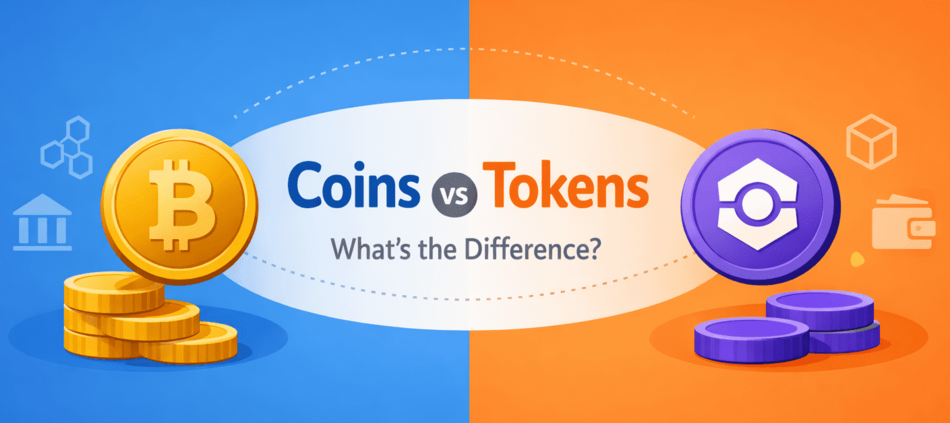
| Coins | Tokens | |
| Blockchain | Own native blockchain | Built on another blockchain |
| Examples | Bitcoin, Ethereum, Litecoin | USDT, UNI, LINK |
| Creation | Requires building or forking a blockchain | Created via smart contracts |
| Primary role | Money or gas fees | Access, governance, assets |
How we explain this simply: A coin is like a country’s native currency – it lives on its own land. A token is like a gift card issued by a store inside that country. The country’s infrastructure supports it.
Why So Many Crypto Currency Types Exist
Bitcoin proved decentralized value transfer works. Ethereum added programmability. Each subsequent wave targeted a narrower problem – stable payments, privacy, governance, tokenized assets – producing different types of cryptocurrencies.
History note: In 2013, nearly every project was a Bitcoin fork trying to be “better money.” By 2017, the ICO boom introduced thousands of utility tokens. By 2020, DeFi and governance tokens dominated. By 2024-2025, real-world asset tokenization and CBDCs entered mainstream discussion. Categories expand as use cases do.
Are All Cryptocurrencies the Same?
No. The differences are substantial:
- Consensus – Proof-of-work, proof-of-stake, and other mechanisms
- Supply – Hard caps versus inflationary versus deflationary burn models
- Governance – Foundation-led versus on-chain community voting
- Privacy – Default transparency versus built-in obfuscation
- Regulation – Security tokens face different rules than payment coins
- Utility – A stablecoin and a governance token solve fundamentally different problems
Disclaimer: This article is for informational and educational purposes only. It does not constitute financial, investment, or legal advice. Cryptocurrency markets carry significant risk, including the potential loss of principal. Always conduct your own research and consult a qualified professional before making any financial decisions.
FAQ Different Types of Cryptocurrencies
- What are the different types of cryptocurrencies?
-
The main types include payment coins like Bitcoin, stablecoins like USDT, utility tokens, security tokens, governance tokens, DeFi tokens, privacy coins, meme coins, NFT tokens, and CBDCs. Most frameworks identify between 8 and 12 categories based on purpose, technology, and governance structure.
- How many types of cryptocurrencies are there?
-
There is no fixed number. Most industry frameworks recognize 8 to 12 broad categories, though thousands of individual coins and tokens exist within them. The count depends on how granularly you define each crypto currency type and whether sub-categories are counted separately.
- What is the most common crypto currency type?
-
Payment coins and stablecoins are the most widely held and traded. Bitcoin dominates payment coins by market capitalization, while USDT and USDC lead stablecoin volume. Together these two types account for the majority of daily transaction activity across major exchanges.
- Are stablecoins a type of cryptocurrency?
-
Yes. Stablecoins are a distinct type of cryptocurrency designed to maintain a stable value, typically pegged to a fiat currency. They use blockchain for transfers and settlement but differ from most crypto in that their value is intentionally stable, backed by reserves or algorithms.
- What's the difference between a coin and a token?
-
A coin operates on its own native blockchain — Bitcoin on the Bitcoin network, for example. A token is built on an existing blockchain using smart contracts, like USDT on Ethereum. The distinction is technical and based on infrastructure, not on value or legitimacy.