
Ethereum Price, NZD Value, Buying Guide & Investment Analysis
- What is Ethereum? A decentralised blockchain platform launched in 2015 that supports smart contracts and decentralised applications, distinct from Bitcoin’s store-of-value focus.
- Ethereum current price fluctuates continuously; always check a live aggregator or exchange for the latest ethereum price usd and ethereum price nzd figures before trading.
- How to buy ethereum NZ: Choose a reputable exchange, complete identity verification, deposit NZD, place a market or limit order, and transfer holdings to a secure ethereum wallet.
- Is ethereum a good investment? Potential upside exists alongside significant downside risk. No asset class guarantees returns.
- Ethereum price prediction models vary widely; short-term movements remain largely unpredictable while long-term outlooks hinge on network adoption and regulatory clarity.
- Where to buy ethereum NZ: Both international platforms (including Binance) and NZ-registered brokers offer access, each with different fee structures and liquidity profiles.
What Is Ethereum?
Ethereum is an open-source, decentralised blockchain platform that enables developers to build and deploy smart contracts and decentralised applications (dApps). It was proposed by Vitalik Buterin in late 2013 and launched in July 2015, making it one of the longest-running programmable blockchains in operation.
So what is ethereum in practical terms? Unlike Bitcoin, which primarily functions as a peer-to-peer digital currency, Ethereum serves as a programmable settlement layer. Smart contracts – self-executing agreements written in code – allow developers to create financial instruments, governance systems, and token standards without intermediaries. This distinction is central to understanding what is ethereum and why its network activity often diverges from Bitcoin’s price behaviour.
Within the broader digital asset ecosystem, Ethereum is often analysed alongside other different types of cryptocurrencies, including payment-focused assets like Bitcoin, smart-contract platforms such as Solana, and utility tokens used within decentralised applications. Understanding how these different types of cryptocurrencies operate helps explain why Ethereum occupies a unique position as a programmable blockchain infrastructure rather than simply a digital payment system.
The platform transitioned from proof-of-work to proof-of-stake consensus in September 2022, significantly reducing its energy consumption. What is ethereum today is effectively a general-purpose computing infrastructure underpinned by economic incentives.
Ethereum Current Price – USD & NZD Overview
Understanding the ethereum current price requires monitoring two reference pairs: the global USD benchmark and the local NZD conversion. When we compared ethereum price usd and ethereum price nzd spreads across several platforms, the variance between pairs was often wider than many new investors expect.
Ethereum Price USD
The ethereum price usd is the global benchmark for the asset. Most institutional trading desks, derivatives markets, and on-chain analytics platforms quote ethereum price usd as the primary reference. Liquidity in USD-denominated pairs is the deepest across all exchanges, meaning tighter bid-ask spreads and lower slippage for large orders.
Because the ethereum price usd reflects aggregate global demand, movements in this pair tend to lead NZD-quoted prices. Institutional trading volumes – particularly through spot ETFs and futures contracts – exert significant influence on the ethereum price usd during North American trading hours.
Ethereum Price NZD
The ethereum price nzd is derived from the USD rate multiplied by the prevailing NZD/USD foreign-exchange rate. This means the ethereum price nzd can move even when the underlying asset price is flat, purely due to currency fluctuations.
In our 2025-2026 review of exchanges available in New Zealand, we noted that ethereum price nzd spreads vary meaningfully between platforms. Local exchanges sometimes carry a 0.5-2.0% premium relative to offshore pricing, reflecting thinner NZD order books and higher operational costs.
| Pair | Key Influencing Factors |
| ETH/USD | Global liquidity, institutional flows, US regulatory news, derivatives open interest |
| ETH/NZD | All USD factors plus NZD/USD exchange rate, local exchange spreads, NZ-specific demand |
The ethereum current price in either denomination should always be confirmed via a live price feed before executing any trade. Cached or delayed prices on informational sites can differ materially from executable quotes.
Ethereum NZ Price vs Global Markets
The ethereum nz price frequently deviates from the global spot rate. In our structured exchange comparison framework, we identified four primary drivers behind this gap.
First, arbitrage efficiency: the ethereum nz price adjusts more slowly than USD pairs because fewer market makers actively arbitrage between NZD order books and global pools. Second, FX rate movement: a weakening New Zealand dollar pushes the ethereum nz price higher even without any change in ETH/USD. Third, liquidity depth: shallower NZD order books mean larger orders can move the ethereum nz price more than equivalent-sized orders in USD. Fourth, exchange-specific spreads: each platform applies its own margin, so the ethereum nz price may differ by several percent across brokers.
In a typical NZ investor scenario we analysed, purchasing NZ$5,000 worth of Ethereum on a local broker versus converting to USD first and trading offshore produced a cost difference of approximately 1.2-1.8% (illustrative example only). Whether that gap justifies the extra steps depends on individual circumstances.
Price of Ethereum – What Drives It?
The price of ethereum responds to a wide range of fundamental, technical, and sentiment-driven factors:
- Network usage and gas fees: Higher on-chain activity increases demand for ETH to pay transaction fees, exerting upward pressure on the price of ethereum.
- Institutional adoption: Spot ETF inflows, corporate treasury allocations, and custody offerings expand the buyer base and influence the price of ethereum at scale.
- Regulatory developments: Legislation affecting staking, DeFi protocols, or exchange operations can shift sentiment rapidly.
- Macroeconomic cycles: Interest-rate policy, risk appetite, and dollar strength all correlate with the price of ethereum, as with other risk assets.
- Layer 2 scaling and ecosystem growth: Rollup adoption can both support long-term value (more users) and suppress short-term gas revenue (lower fees per transaction).
Understanding these drivers is essential context for anyone monitoring the price of ethereum or considering an allocation. No single catalyst operates in isolation; the price of ethereum emerges from the interplay of all five categories simultaneously.
Ethereum Price Prediction
Any ethereum price prediction should be treated with caution. Models that attempt an ethereum price prediction range from stock-to-flow adaptations to network-value-to-transaction ratios, and they frequently disagree.
Short-term outlook: In the near term, ethereum price prediction is heavily influenced by sentiment, liquidation cascades, and macroeconomic data releases. Based on our internal volatility tracking checklist, short-term forecasts have historically shown wide confidence intervals, making precise ethereum price prediction unreliable over weeks or months.
Long-term considerations: Longer-horizon ethereum price prediction models tend to focus on adoption curves – active addresses, developer activity, total value locked in DeFi, and Layer 2 transaction volumes. If Ethereum maintains its position as the dominant smart-contract platform, these models generally point to growth potential, but none should be mistaken for guarantees.
| Factor | Short-Term Impact | Long-Term Impact |
| Layer 2 rollup adoption | May reduce mainnet fee revenue | Expands user base and ecosystem utility |
| Spot ETF flows | Direct price pressure (positive or negative) | Broadens institutional ownership |
| Regulatory clarity | Volatile reactions to headlines | Establishes legal framework for sustained growth |
| Staking yield changes | Marginal effect on selling pressure | Influences long-term holder economics |
| Competing L1 blockchains | Narrative-driven rotation | Determines whether Ethereum retains market share |
An ethereum price prediction is a scenario analysis tool – not an investment thesis. No forecast should substitute for personal due diligence.
How to Buy Ethereum in NZ
For anyone asking how to buy ethereum, the process in New Zealand follows a standardised sequence. Here is how to buy ethereum in five steps:
- Choose an exchange: Select a platform that supports NZD deposits. You can buy ethereum on international exchanges or NZ-registered brokers. To buy ethereum binance is one option; local platforms are another.
- Verify your identity: All regulated platforms require KYC (Know Your Customer) documentation. Have your NZ driver’s licence or passport ready.
- Deposit NZD: Fund your account via bank transfer, POLi, or debit card depending on the platform. Fees and processing times vary.
- Place your order: You can buy ethereum using a market order (immediate execution at current price) or a limit order (execution at a specified price). Understanding how to buy ethereum with limit orders can reduce slippage.
- Secure your holdings: Transfer ETH to an ethereum wallet you control. This is the most frequently overlooked step in how to buy ethereum safely.
For those specifically researching how to buy ethereum nz, the key differentiator is NZD payment support. Not all international exchanges accept direct NZD deposits, which is why understanding how to buy ethereum nz often involves evaluating on-ramp availability.
Buy Ethereum – Exchange Comparison Considerations
When you set out to buy ethereum, exchange selection matters more than many realise. In our structured exchange comparison framework, we assessed four critical factors:
| Factor | Why It Matters | Typical Impact |
| Trading fees | Directly reduces net position size | 0.1%-1.5% per trade depending on platform |
| Spread (bid-ask) | Hidden cost above the quoted ethereum current price | 0.2%-2.0% on NZD pairs vs 0.05%-0.3% on USD pairs |
| Liquidity depth | Determines slippage on larger orders | Thinner books = higher cost to buy ethereum in size |
| Withdrawal policy | Affects how quickly you can move ETH to an ethereum wallet | Some platforms impose holding periods or elevated withdrawal fees |
You can buy ethereum binance as a well-known international option with deep liquidity across multiple pairs. To buy ethereum binance, NZ users typically deposit via international transfer or card payment. However, when comparing where to buy ethereum, Binance should be assessed alongside other platforms on the factors listed above.
To buy ethereum nz effectively, prioritise total cost – not just headline trading fees. Spread costs can exceed stated commissions, especially during volatile sessions.
Where to Buy Ethereum NZ
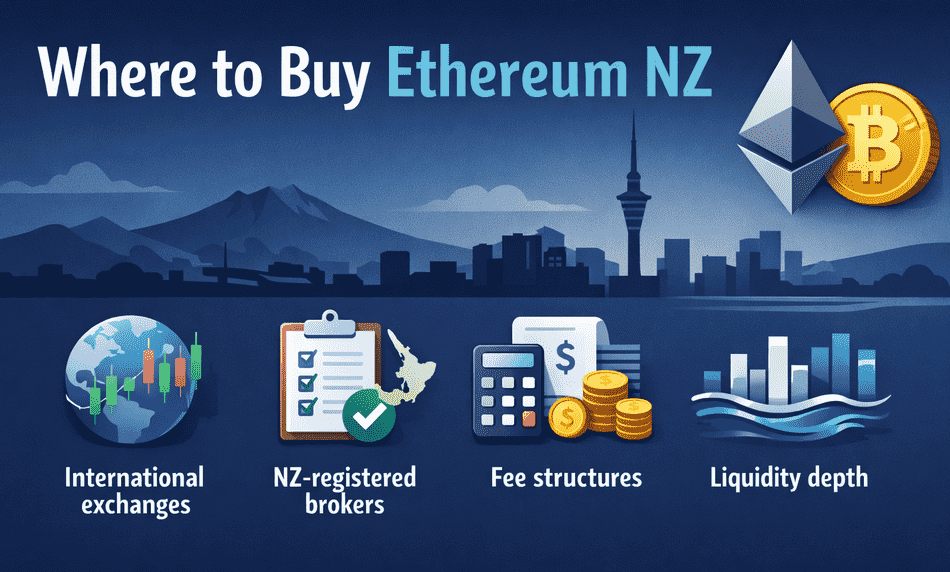
Where to buy ethereum nz depends on individual priorities: cost, convenience, regulatory comfort, or feature set.
- International exchanges (e.g., buy ethereum binance): Generally offer the deepest liquidity and tightest spreads. To buy ethereum in new zealand through these platforms, users must navigate international payment rails and potential FX conversion charges.
- NZ-registered brokers: Accept direct NZD deposits with local bank integration. Spreads may be wider, but the process to buy ethereum nz is typically more streamlined for local users. Where to buy ethereum nz locally often comes down to comparing two or three established brokers.
- Fee structures: Maker-taker models, flat percentage fees, and spread-based models all exist. Knowing how to buy ethereum nz cost-effectively requires comparing effective all-in costs, not just advertised rates.
- Liquidity depth: If you plan to buy ethereum in new zealand in amounts exceeding NZ$10,000, order-book depth becomes a practical consideration. Where to buy ethereum nz for larger trades may differ from optimal platforms for small recurring purchases.
Where to buy ethereum nz is ultimately a personal decision. Buy ethereum in new zealand through whichever channel best aligns with your cost sensitivity, security requirements, and trading frequency. Buy ethereum new zealand options continue to expand as the local market matures, with both domestic and international platforms competing for NZ-based users who want to buy ethereum new zealand conveniently.
Ethereum Wallet Options
An ethereum wallet is essential for anyone who intends to hold ETH beyond a short-term trading position. From our review of wallet security standards, the choice of ethereum wallet has material implications for asset safety.
- Hot wallets (software-based): Mobile and browser extensions offering convenient access. An ethereum wallet of this type connects directly to dApps but is exposed to internet-based threats.
- Hardware wallets (cold storage): Offline devices that sign transactions without exposing private keys. This type of ethereum wallet is widely considered the most secure option for long-term holdings.
- Custodial wallets: The exchange holds your keys. Convenient but introduces counterparty risk – if the platform fails, your assets may be at risk.
- Non-custodial wallets: You hold the private keys. Full control, but full responsibility for backup and security of seed phrases.
| Wallet Type | Risk Level | Control Level |
| Hot wallet (non-custodial) | Medium – internet exposure | Full – user holds keys |
| Hardware ethereum wallet | Low – offline key storage | Full – user holds keys |
| Exchange custodial wallet | Variable – depends on platform security | Limited – exchange holds keys |
An ethereum wallet strategy should match the holder’s technical confidence and investment horizon. Residents who buy ethereum new zealand locally often begin with exchange custody before transitioning to a personal ethereum wallet as their understanding develops.
Is Ethereum a Good Investment?
The question “is ethereum a good investment” has no universal answer. Here is a balanced overview:
Potential positives:
- Largest smart-contract ecosystem by developer activity and total value locked
- Deflationary supply mechanics post-EIP-1559 under high network usage
- Growing institutional exposure via spot ETFs and staking products
- Layer 2 scaling broadening the potential user base
Potential negatives:
- High historical volatility – drawdowns of 50-80% have occurred in previous cycles
- Regulatory uncertainty in multiple jurisdictions
- Competition from alternative Layer 1 platforms
- Technology risk – protocol upgrades carry implementation risk
Is ethereum a good investment for a particular individual depends on their risk tolerance, time horizon, and portfolio context. Is ethereum a good investment in absolute terms? That depends on future adoption trajectories that remain uncertain. Is ethereum a good investment relative to other digital assets? Reasonable analysts disagree. No one should treat any single perspective on whether is ethereum a good investment as definitive.
Ethereum NZ Market Overview
The ethereum nzd market has grown steadily alongside broader digital-asset adoption in New Zealand. Local exchange volumes in ethereum nzd pairs remain a fraction of global USD trading, but have increased year on year.
Demand trends in the ethereum nz space reflect both global sentiment and local factors such as RBNZ monetary policy and New Zealand dollar strength. The ethereum nzd pair is particularly sensitive to NZD/USD fluctuations during Asian trading hours, when NZ-based participants are most active.
In practice, NZ-based traders rarely monitor a single asset in isolation. During our exchange comparison analysis, we observed that many investors track several NZD trading pairs simultaneously, including ETH/NZD, BTC/NZD, and meme-driven assets such as dogecoin nzd, which tends to attract higher retail trading activity during periods of strong social-media momentum.
Pricing variations across ethereum nz platforms remain evident. In a typical NZ investor scenario we analysed, the spread between the highest and lowest ethereum nzd quote at any given moment ranged from 0.8% to 2.5% (illustrative example). Comparing ethereum nz options before executing remains prudent. The ethereum nzd landscape in New Zealand continues to mature as more platforms enter the market and competition narrows spreads.
Disclaimer: This article is for informational and educational purposes only and does not constitute financial, investment, or legal advice. Cryptocurrency markets are highly volatile, and the value of digital assets can decrease as well as increase. All numeric examples are clearly illustrative and do not represent live prices or guaranteed outcomes. Always conduct your own research and consider seeking independent professional advice before making investment decisions.
FAQ Ethereum NZ
- What is ethereum?
-
Ethereum is a decentralised blockchain platform that supports smart contracts and decentralised applications. Launched in 2015, it differs from Bitcoin by functioning as programmable infrastructure rather than solely a digital currency. Its native token, ETH, is used to pay network transaction fees.
- How to buy ethereum?
-
To buy ethereum, select a cryptocurrency exchange, complete identity verification, deposit funds, and place a buy order. You can use market orders for immediate execution or limit orders for price control. After purchasing, transfer ETH to a secure ethereum wallet for safekeeping.
- How to buy ethereum NZ?
-
To buy ethereum nz, choose a platform supporting NZD deposits — either an NZ-registered broker or an international exchange with NZD on-ramp. How to buy ethereum nz cost-effectively involves comparing spreads, fees, and withdrawal policies across providers before committing.
- Is ethereum a good investment?
-
Whether ethereum is a good investment depends on individual risk tolerance and financial goals. The asset has shown significant growth potential alongside extreme volatility. Past performance does not indicate future results. Professional financial advice is recommended before making allocation decisions.
- Ethereum current price?
-
The ethereum current price changes continuously across global exchanges. For the most accurate ethereum current price, check a live aggregator or your chosen trading platform. Cached prices on informational websites may be delayed by minutes or hours.